Rethinking the injection molding machine
Published: February 28th, 2011
Can one inventor change the way plastics is injection molded using a homemade machine from his basement? Rick Fitzpatrick, a molding veteran with tool design stints at the former Courtesy Corp. (now Rexam) and Capsonic, has long questioned the current molding model of large machines and large multicavity molds, and for the last 10 years, he has manifested those doubts in smaller machines that re-imagine the molding process. His goal: "getting to the size of a machine that actually prepares plastic economically."
"Why is it that an injection molding machine can cost $500,000," Fitzpatrick asked, "but I've got more control at my fingertip with a hot glue gun? Everyone looks at injection molding having to be all of these cavities, because everyone equates cheap parts with all these cavities, and they don't really understand the machine cost, the cost of floor space, the cost of labor to support that machine, so literally what you end up with are very high capital costs for marginal profits."
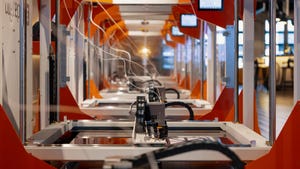
Fitzpatrick's answer has gone through number of iterations but boils down to small, table-top machines that combine a continuous extrusion screw with a plunger system running down its center to deliver plastic that's heated at the nozzle. In a 2004 video, he shows an early prototype based on a multipurpose machine purchased from discount hardware supplier, Harbor Freight. Using a lathe spindle to turn the screw, which is itself a modified wood auger, the small prototype, which is not running a mold, rapidly piles molten polypropylene on a table. Heating comes from two small 250W heaters, with the 200-rpm spindle running 110V and plugged into the wall.
"I thought, 'Man, if I can pump plastic like this, at these rates, what do I need a big machine for?'" Fitzpatrick recalls. In larger machines, Fitzpatrick notes shear heat is required to melt plastic, and to achieve shear heating large batches of resins must be prepared. To safely accommodate the melt stream, large barrels and machines are required. In his system, small batches of plastics are heated on an as-needed basis to specified temperatures, with the lower-pressure environment allowing barrel-wall thicknesses down to 1/8-inch.
As part of the paradox of large machines, Fitzpatrick points to hot runner systems. "If I've got a hot runner system and it's sitting there and can hold this polypropylene at 300°F or whatever," Fitzpatrick asked, "why do I need that whole machine to move it two inches across a plate? That's when I started playing with this idea of small machines."
Fitzpatrick says for the $22,000 to $24,000 you might pay for an eight-cavity mold, he can create a machine with a four-cavity mold for the same price. To promote the program, Fitzpatrick has joined the MYOS (make your own stuff) community online, and will use that platform to initially push the technology to do-it-yourselfers, inventors, and hobbyists. After a decade of work, Fitzpatrick is hopeful his concept can catch on.
"In all these years, it's really hard, it's like pushing everything up hill," Fitzpatrick says. "I go to plastics guys, and they'll agree with everything and then it will come down to: it's too high risk, if it were so good everyone would be doing it."
Because of that, Fitzpatrick is changing his target audience for the systems. "I've been a failure at trying to sell to the people who learned how to tame the big dinosaur, and I don't really want to go after them anymore because it's a losing proposition," Fitzpatrick says, "but there are a lot of little guys who need a lot of little parts. What was the first question in our target marketing meetings at Capsonic: What's the volume? If it's under 75,000 pieces/yr for insert molding, we ain't doing it, go away."


There is precedence here! I'm
There is precedence here! I'm sure there are plenty of ol'timers out there that remember the Arburg C4b machines. Pneumatic operated and no screw. Instead, it had a vertical plunger pushing on a metered amount of plastic pellets at the feed entrance to create injection pressure. I molded many parts on these machines, but (like the one in the video) they were dangerous. If I remember correctly, Arburg tried to buy them all up just to get them out of the market because of the liability.
At 4:50, I shivered as I saw
At 4:50, I shivered as I saw the guy reach into the mold to grab the part. That's a good way to lose your hand, like there is a "good way.
Patrice
It seems like a good idea, at
It seems like a good idea, at first and since I have been building molds and molding parts for over 30 years I have more than a little experience to comment on this. I too, advocate running fewer cavities on smaller machines and make more small molds to put in more small machines to make more parts per day if needed.
However, what many people that have not processed injection molded parts don't understand is that the pressures, injection speeds and even on many molds the mold opening/closing speed and the ejection force and speed are just a few of the things that need very close control of on many parts. I mold a lot of Duck Call parts, wall thickness of up to .375", in polycarbonate, these parts require packing pressures of 20,000 pounds per square inch of pressure and up to 10 seconds of holding at that pressure to get good parts. That seems to me something that will be difficult to do on light weight, simple control machines. Getting a leak of 500 degree F heated PC at 20,000 PSI in your face can ruin more than just your day.
If you look back at the earliest plastic molding machines they were actually built very much as Rick has proposed, but there is more reasons than just the machine makers wanting to sell expensive machines that caused the industry to move to larger, faster and better controlled machines.
Also, there are several companies that already make small table top type machines that run on low voltage and hand or air power. They work fine for simple parts and easy polymers, in both prototyping and short run production.
Rick sounds like a man after
Rick sounds like a man after my own heart. I have been digging into plastics for the last couple of years as I am convinced that the various forms of working with plastics is the way I might be able to produce a model flying machine that I have patented.
I am an old guy with not an abundance of energy left but my worshops is still my favorite place.
I am working on many different aspects of plastics, as even without any experience in the plastics business during my eighty-one years, I long ago came to the conclusion that if I could build a benchtop kind of injection molding machine it might be one of my answers. I have never been able to figure out why the Shot Size is so small in so many of the machines I study, and with my lack of experience, feel that all you need is lot of heat and a lengthy plunger, and already have the idea of using my Atlas lathe for plunger power.
That unit is a work in progress. I have also made a half assed Rotational Molder, as that technique seems to have promise also.
I have been trying of late to find time to pursue vacum molding as it seems the simplest of all the processes, and am hoping I will be able to come up with some nice small rotor blades using that process.
Just thought I would jot this down here as we both seem to have the same ideas.
Would be pleased to hear from you.
Jarl Plottner jplottner2@neo.rr.com