Why reshoring?
Published: June 29th, 2012
I was at a client's subcontractor in Mexico. The room was the size of a basketball court. There were probably 10 huge rotating tables each with a dozen workers sitting at the various stations: cutting tubing to length, solvent-welding tubes to connectors, coiling the product, etc. You could get a contact high off the hexane in the air. I'd been told the job had been relocated from the States to take advantage of low wages.
Yup, Mexican labor, like most low-wage countries', gives significant savings over U.S. labor. This wasn't a problem if you could accept the high turnover rates (20%+), the hand-generated scrap, and the disappointing yield rates at the final test station. However, for a medical IV product, it somehow was profitable.
I'd finished my assignment and came back to the U.S. With my follow-up report and the subsequent phone calls I asked the "King-has-no-clothes" question: "Why are you in Mexico? Assuming the personnel problems and yield aren't part of the equation?" I then got the speech on using low-wage countries and would I be interested in helping relocate this operation to China? I answered his question with another one:
"Why not automate the whole thing and it can be located anywhere there's electricity?"
My rough calculations showed less than a year's payback at the same yield rates and probably a six-month ROI because with automation the yields would be 99.9%+. What was interesting was the answer (for the moment we'll ignore the possibility of politics, international trade negotiations, and other silliness): "Yes, but...Third World wages are much lower than the U.S."
In any context anyone who says "Yes, but..." is really saying they've only acknowledged you opening your mouth. Whatever came out of it might has well been said to an empty room. They don't want to hear it. "Yes, but... " stems from the first two generic excuses: 1) "We always did it that way," and 2) "It's convenient". Both of these excuses come from a mentality that relies on tradition and is afraid of innovation. History tells us those who insist on doing things "The Olde Way" are eventually put out of business by those who innovate using newer proven techniques to improve profits. Enough said.
Let's look at the facts of the Off Shore Decision. You've developed a product and its associated process. Since prototyping is usually a hand-made philosophy, very few people think in the initial stages of the product development that they'll automate the process in production. What starts out being labor intensive—The Olde Way—stays that way. Since labor is the primary component of the product cost (never looking at the final landed costs into your distribution network) you expand your supply chain and look for a way to lower the labor costs. The most immediate answer is to go to a low-wage environment, read: off shore.


This then creates another layer of infrastructure hilariously known as Supply Chain Management. Supply chain Management, on a day-to-day basis, is an ongoing exercise in herding cats: Paying for expedited freight (someone else's budget); jerking schedules around usually knowing promises won't be honored; locating lost shipments; paying for maintenance on poorly built tooling (just because you specified an SPI Super Spiffy mold doesn't mean you'll (1) get it or (2) someone can't damage it or wear it out in 25,000 cycles); language barriers; and the ultimate "lost in translation" problems of cultures, local politics, religion, etc.
"But it's too late to automate" they whine.
If it's a custom product at the end of its life cycle, maybe that's the correct answer. But look at what's off shore: Wiring cables, Medical IV sets, and many assembly operations. These (generically) have an infinite life span. Now you get the argument of custom-built automation, and its associated expense (the "Yes, but..." excuse). But again they missed what you've said. Solvent welding a tube into a connector, or insert molding a plug onto a set of wires, fastening part A into part B are generic processes. So why not tool up a generic machine using as many standard components as possible whose only changeover would be the end-of-arm-tooling that is product specific? This machine could be used for many products or product lifetimes.
To do this you must have a vision and the initial determination to design your product and its components for automation. You must also have the commitment that once you've built this equipment it must produce the same-quality parts in the same volumes anywhere in the world. If your market is in Europe, South America, or anywhere else, your biggest decision is where you can locate your machine or; do you build multiple machines and have multiple manufacturing sites? Now, if your want to produce in Boston or Beijing, your only problem is finding people to feed it components and maintain the equipment.
Is this novel or new thinking? Nope. Look at Husky. They've built turnkey plants all over the world. There are several excellent automation shops all over the U.S. and Europe that will interface with your molding equipment and assembly lines.
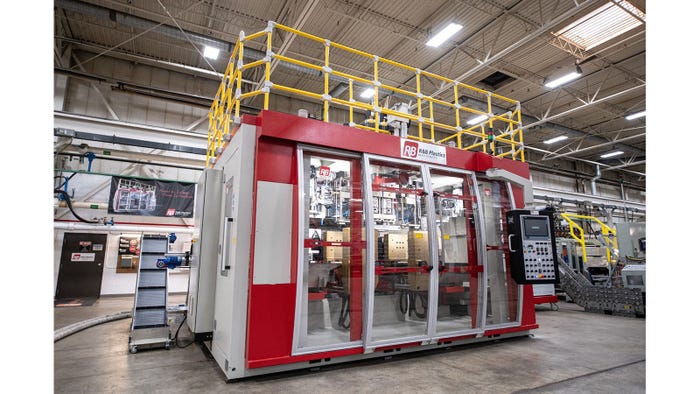
Instead of a room full of hexane fumes and a hundred-plus people busily putting things together, you have one multi-station unit where you feed components into shaker bowls and tubing from a coiler and out the other end come your finished products, coiled in a bag, and ready for gamma sterilization.
Is this good (profitable) thinking? Take a tour of your plant or look at your off shore facilities. Think about how much you could lower your product costs and improve your profits: and stop saying "Yes, but..."
It's your choice.