Simulation software calculates heat transfer of all mold components over multiple cycles
Published: January 6th, 2012
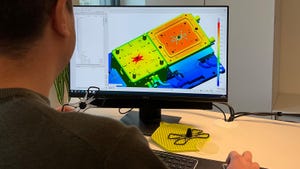
By calculating multiple consecutive production cycles and taking into account the thermal interactions throughout all the components in the mold, Sigmasoft's "multi-cycle analysis" boosts the accuracy of an injection molding simulation. Sigma Plastic Services presented its Sigmasoft 3D injection molding process simulation software at the recent Euromold 2011, highlighting its multi-cycle analysis feature as a new benchmark in injection molding simulation.
![]() |
| On the left, temperature distribution in a half of the mold cavity after one cycle; on the right, the temperature distribution after 15 cycles. |
In conventional software, a fixed mold temperature is defined and the whole simulation is carried out under the assumption that this value remains constant over time, noted Marco Thornagel, executive director of Sigma Engineering.
In reality, however, Thornagel notes that a very complex thermal process is taking place within the mold. As the steel is cooled with a tempering system, the mold is then heated when the hot polymer melt enters the cavity and there is a loss of thermal energy towards the surrounding environment. The heat transfer properties of the polymer melt, runner system, inserts, and mold all contribute to the final temperature.
"Only when these complex interactions are considered will the real production conditions be reproduced in the simulation," Thornagel said. Sigmasoft's 3D approach allows all the components in a mold, including all their individual thermal and physical properties, to be exactly reproduced. Sigmasoft says this allows the heat transfer process to be accurately calculated between each one of the components.
The simulation attempts to exactly reproduce the heat-up during machine start-up, when the mold is heated from room temperature to its production conditions. It also includes the warming produced by the hot polymer melt over several consecutive pre-production cycles. Sigmasoft then simulates the thermal evolution of the mold over multiple consecutive production cycles.
This holistic calculation is reportedly able to predict the real temperature in each location of the mold during production, producing conditions that Sigmasoft says more closely reflect reality for the polymer as it sets inside the cavity. Through this, the software can predict how long the polymer remains in a fluid condition so that post-pressure can be applied, or where thermally induced deformation could be most likely to compromise part quality.
Multi-cycle simulation also makes it possible to calculate how many production cycles are required for the mold to achieve cyclic equilibrium, allowing molders to compare the efficiency of different tempering systems to understand how to achieve that equilibrium more quickly and consume less energy.