Plant tour: Single-machine shop sets standards in micro sphere
Published: March 19th, 2009
Thinking small has significant potential in diagnostic devices.
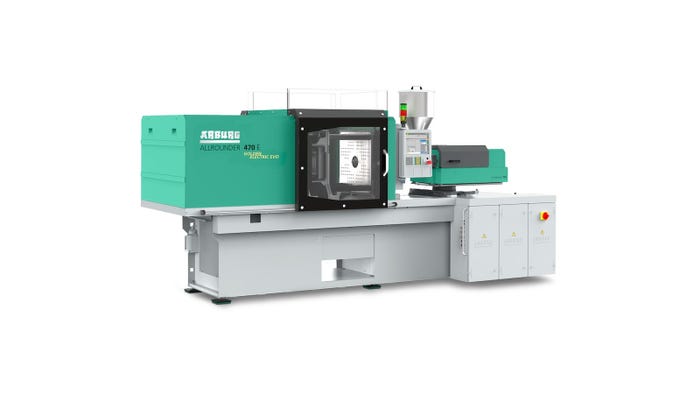
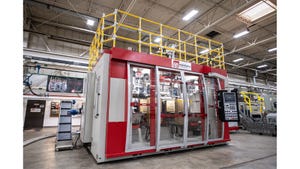
With a single 60-metric-ton Toshiba all-electric injection press to its name, MiniFAB’s molding operation couldn’t get much smaller. But the machine’s being put to good use as a core component of the company’s core business: the design, integration, and manufacture of polymer-based micro-engineered systems for the biotech, health, agriculture, food, and environmental sectors.
MiniFAB received its production site in kind from an investor, and sublet MiniFAB’s Erol Harvey outside A tooling insert made MiniFAB offers turnkey services for The 60-metric-ton Toshiba all-electric is good for up to 1.5 million parts annually in cavitations of one to four. A biosensor incorporates check valves, fluidic channels, pneumatic channels, and peristaltic pumps. The manufacturing team fabricates circuit patterns on microfluidic Vacuum sputtering of gold followed by laser patterning is used to inscribe circuitry into plastic substrates. MiniFAB molds all its components in-house, including external ones. Electrodeposition toolmaking technology commonly |
MiniFAB was established in 2002 under a unique arrangement between Melbourne’s Swinburne University (which developed the underlying technology portfolio), a business park developer, and a designer and constructor of high-tech manufacturing facilities. Explains Erol Harvey, CEO of MiniFAB, “We provided much of the equipment for startup from the university, and in any case we were running out of room for it on campus. One of our private sector partners, The Caribbean Business Park, provided us with a 45,000-ft2 building rent-free for three years, while a second local partner, Wilkore, built our production facility.” After three years, the financial contributions of the three parties were tallied up and converted to equity in the privately held company, with staff also receiving stakes.
“Our facility within the building only occupies around one-seventh of the total floor space, so we started to sublet the remainder to other startups focused on similar activities,” adds Harvey. “This not only generated cash flow, but also a nice micro and nano technology cluster emerged and we enjoy synergies with like-minded startups.” One tenant even runs an Engel injection machine.
Today, MiniFAB’s Class 10,000 cleanroom-based injection press is molding around a million components annually from a variety of resins for use in commercial products such as disposable diagnostic biosensors and genetic analysis sensors. These “biochips” are typically molded from transparent resins such as polycarbonate and incorporate molded-in microfluidic channels that are around 100 µm deep with a 0.5-µm (500-nm) tolerance.
Resin is predried in a room adjacent to the one that houses the injection machine, itself topped with a tiny hopper on account of the small shot size typically employed. Laser profile measurement is carried out at the batch level to ensure products are within specification.
After the substrates have been molded, they are loaded into trays and transferred to another Class 10,000 cleanroom for further processing. Following cleaning with 10 kilohm-meters/cm deionized water, they are sputtered with gold, and then laser patterning is used to create 60-µm-wide electrical circuits with a 1-µm tolerance. “We didn’t consider molded interconnect devices [MIDs] as a technology option because of the tight tolerances required,” says Harvey. MiniFAB then proceeds to take the semi-finished substrate to final assembly as a diagnostic cartridge. External parts that enclose the substrate are also molded in-house.
“The biggest challenge with injection molding microfluidic substrates is combining relatively large features alongside very small features due to differences in mold shrinkage,” says Harvey. “With DVDs, for example, the features are uniform across the whole disk, but with a microfluidic substrate, you might have a 3-mm feature next to a 0.5–µm one.
“It’s not the size of the features themselves that presents the biggest challenge,” he adds. “The shrinkage around the large feature could distort the fine feature, or you might overpack the large feature, which is not good for the small feature. We have to design to compensate for this.”
Alternative processes
For low production volumes, MiniFAB turns to other processes such as rapid prototyping, hot embossing, and nanoimprint lithography (NIL). “One of our areas of expertise is the ability to ramp up production by switching processes without having to redesign the device or change the material,” notes Harvey. “It doesn’t matter if it is rapid prototyping or injection molding. The part will run equally well using the same material. One of our core competencies is to take products from prototype to mass production.”
Disposable diagnostic cartridges are set to become a major growth market in the medical segment as device manufacturers develop so-called point-of-care (POC) diagnostic equipment that will migrate various specialized tests from hospital-based ones requiring the skills of expert white-coated medical staff handling pipettes and reagents and the like into ones that can be handled in a general practitioner’s office. “We will see pathological testing moving from the laboratory to the doctor’s waiting room, and ultimately to the home,” says Harvey. The current market is valued at $16.7 billion in the United States and is growing at 14%/year.
Silicon vs. plastic
Harvey notes that given its strengths in the semiconductor field, the United States is very much focused on the use of silicon to fabricate disposable diagnostic cartridges as opposed to the plastics route being adopted in Australia. “We want to use commodity plastics wherever possible,” says Harvey, although exotic cyclic olefin copolymer (COC) is sometimes used. COC is UV-transparent so it does not fluoresce. This attribute is handy in that laser fluorescence is a tool commonly used in diagnosis. There are issues with COCs, however. Besides being costly, batch-to-batch variation is significant, and changes in impurities can affect chip reliability. “We are such a tiny user that we don’t have the clout to prompt suppliers to work on improving purity,” Harvey laments.
MiniFAB also takes full responsibility for the design of the various sensors it manufactures. “Our business model is to assist in building the patent portfolio of our client,” says Harvey. “We will be contracted by them to develop new products often based on university research that they’ve licensed. In doing so, we will build on their patent portfolio, and what we seek in return is a long-term manufacturing contract.”
One such product is the diagnostic cartridge for the TearLab in vitro diagnostic tear testing platform from OcuSense (San Diego), which debuted in Europe late last year. The TearLab is used to detect eye diseases, but as the technology advances and sensitivity improves, similar devices may one day be able to detect diseases such as cancer from teardrops. To this end, MiniFAB is participating in the EU’s SmartHealth Integrated Project that targets development and delivery of the next generation of smart diagnostic systems fully integrated into healthcare systems in Europe. SmartHealth is driven by key applications in cancer diagnostics. Furthermore, in a contribution to development of the local high-tech sector, MiniFAB makes its equipment available under the Australian government’s Small Technologies Cluster (STC) Access Program for research purposes.
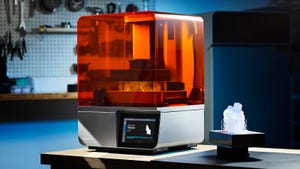
MiniFAB also makes its own tooling using the electroforming process commonly used in fabrication of stampers for optical media and light guide panels. The process entails steps such as laser micromachining of PC or PVC plates, sputtering with silver or copper to make the plates conductive, and coating with nickel to produce the final insert, which is positioned in the tool to submicron precision.
Electroforming of relatively high-aspect-ratio stampers presents its own challenges, especially in the need for clean conditions. “Whereas DVD stampers are essentially flat, we are talking of features that could be 50 µm across and 300 µm deep. If there is any contamination in the nickel it will change the hardness and features could break away if there are just a few contaminant atoms present,” says Harvey.


MiniFAB has even extended its stamper fabrication expertise to develop an electroformed “tool” that wraps around printing rollers used for printing plastic flexible packaging. “The tool makes micro-indentations in the packaging film, which makes bags easier to open,” says Harvey. This flexible approach to the application of plastics processing techniques bodes well for growth of MiniFAB’s microprocessing world. —stephen.moore@cancom.com